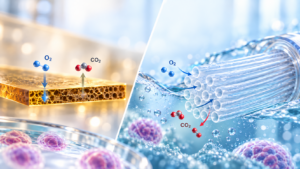


The basic idea behind sewage treatment is simple: we use microorganisms to eat up organic waste. To keep these microbes working hard, we have to feed them oxygen. Traditionally, this is done in two ways: either by keeping the microbes floating in the water (activated sludge) or by giving them a surface to grow on (biofilm).
The MABR (Membrane Aerated Bioreactor) belongs to the biofilm family, but it’s often confused with the MBR (Membrane Bioreactor). The difference is actually huge. In an MBR, the membrane acts like a filter to strain the water. But in an MABR, the membrane acts more like a lung—it delivers oxygen directly to the bacteria growing on its surface.
The big selling point here is energy efficiency. Traditional systems waste a lot of power blowing bubbles into huge tanks of water. MABR doesn’t need that constant, aggressive aeration because the oxygen goes straight where it’s needed. This is why everyone is looking at it as a “green” alternative. Usually, these membranes are made from silicone rubber or polyolefin hollow fibers.
What’s really clever is how we can use “oxygen-enriched” carriers—basically silicone fibers wrapped in a fine polyester fleece. Because the oxygen is coming from the inside of the fiber out, you get a high-oxygen zone right at the base of the biofilm where nitrification happens. Meanwhile, the outer layer of the film handles the organic waste.
Instead of needing three or four different tanks and stages to clean the water, an MABR can handle organic removal and nitrogen treatment all in one go. It’s a much more compact and elegant way to get advanced treatment results without the massive footprint.