

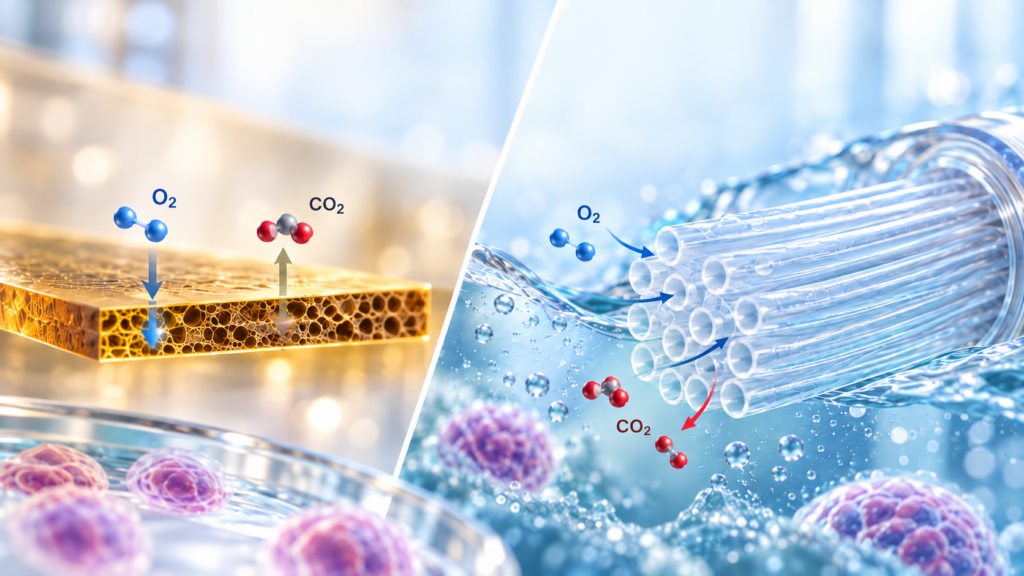
Choosing the right gas exchange membrane is one of the most important design decisions for medical and bio-related devices that supply O2 or remove CO2 from a liquid. This article compares two representative polymer membranes — Polyimide (PI) and PDMS (silicone) — and explains why PDMS hollow fiber membranes are widely used for bubble-free gas transfer in applications such as oxygenators and cell culture systems.
The key question to ask when selecting a membrane material is not simply “which membrane has the highest selectivity?” but rather:
Do you need to separate gases, or do you need to move gas efficiently across the membrane?
Polyimide: Optimized for Gas Separation
Polyimide has a relatively rigid polymer backbone, which makes it well suited to selective gas separation based on differences in permeation rate between gas species. For this reason, Polyimide membranes are widely studied for gas separation applications such as H2/CO2 and CO2/CH4 separation.
PDMS: Optimized for High Gas Permeability
PDMS (polydimethylsiloxane), by contrast, is a rubbery polymer built on a flexible –Si–O–Si– backbone. Its high chain mobility allows gases to dissolve into and diffuse through the membrane easily, giving PDMS exceptionally high gas permeability compared to glassy polymers like Polyimide.
Gas Permeability Comparison: PDMS vs. Polyimide
| Membrane | O2 Permeability | CO2 Permeability |
|---|---|---|
| PDMS (silicone) | ~500–600 Barrer | ~1,850–2,100 Barrer |
| Polyimide (Matrimid® 5218) | ~1.9 Barrer | ~8.3 Barrer* |
*Reported values for Matrimid® 5218; see reference below.
Because membrane structure, thickness, temperature, and pressure conditions differ between studies, these Barrer values cannot be used to directly predict real-world module performance. What matters for material selection is the underlying property each polymer brings to a gas exchange membrane design: Polyimide offers selectivity, while PDMS offers high gas permeability.
Why High Gas Permeability Matters for Medical & Bio Applications
When the goal is to separate one gas from a mixed gas stream, selectivity is the critical property.
But when the goal is supplying O2 to a liquid or removing CO2 from a liquid, the membrane itself does not need to distinguish between gas species. As long as an appropriate partial-pressure gradient exists across the membrane, gas transfer proceeds naturally in both directions:
- O2 transfer: Gas → Membrane → Liquid
- CO2 transfer: Liquid → Membrane → Gas
This is why, in gas-liquid exchange applications, what matters most is a membrane that allows the target gas to dissolve and diffuse through it efficiently — in other words, high gas permeability rather than gas selectivity.
In practice, PDMS’s high O2 and CO2 permeability has made it a widely studied material for gas exchange membranes in artificial lungs (oxygenators) and related biomedical devices.³
Non-Porous PDMS Membranes: Bubble-Free Gas Transfer
NAGASEP’s silicone hollow fiber membranes are non-porous membranes. Rather than releasing gas as visible bubbles through membrane pores (as porous membranes do), gas transfer occurs through the solution-diffusion mechanism:
Gas → dissolves into PDMS → diffuses through the membrane → dissolves into the liquid
Because gas moves through the polymer matrix itself rather than through physical pores, non-porous PDMS hollow fiber membranes can deliver bubble-free gas transfer to liquids under appropriate operating conditions — a critical requirement for many medical and cell culture applications where visible gas bubbles are undesirable or unsafe.
Choosing a Gas Exchange Membrane: Key Takeaway
When selecting a membrane for a medical or bio-related device, the right question isn’t only “which membrane has the highest selectivity?” It’s whether your application needs gas separation or efficient, bubble-free gas exchange. For O2 supply and CO2 removal in liquids, a high-permeability, non-porous PDMS hollow fiber membrane is often the better fit.
About NAGASEP PDMS Hollow Fiber Membranes
NAGASEP manufactures PDMS (silicone) hollow fiber membranes for gas exchange applications and offers customization to match your research or device requirements, including:
- Hollow fiber length
- Number of fibers
- Membrane surface area
- Module specifications
Contact NAGASEP to discuss a PDMS hollow fiber membrane module tailored to your gas exchange application.
Reference
*Polyimide (Matrimid® 5218) gas permeability: “Gas Transport Properties of Mixed Matrix Membranes Based on Matrimid® 5218.” https://pmc.ncbi.nlm.nih.gov/articles/PMC8950901/


